Researching 80,000 leads without paying for 80,000 deep dives
The cheapest source that can answer always goes first.
The situation
An outbound campaign needed more than 80,000 leads researched to 29 data points each, starting from little more than a name and a website. No single data provider had all 29 fields. Running every lead through every expensive tool would have cost more than the campaign was worth, and guessing the gaps would have wrecked the sender's reputation inside a week.
What I built
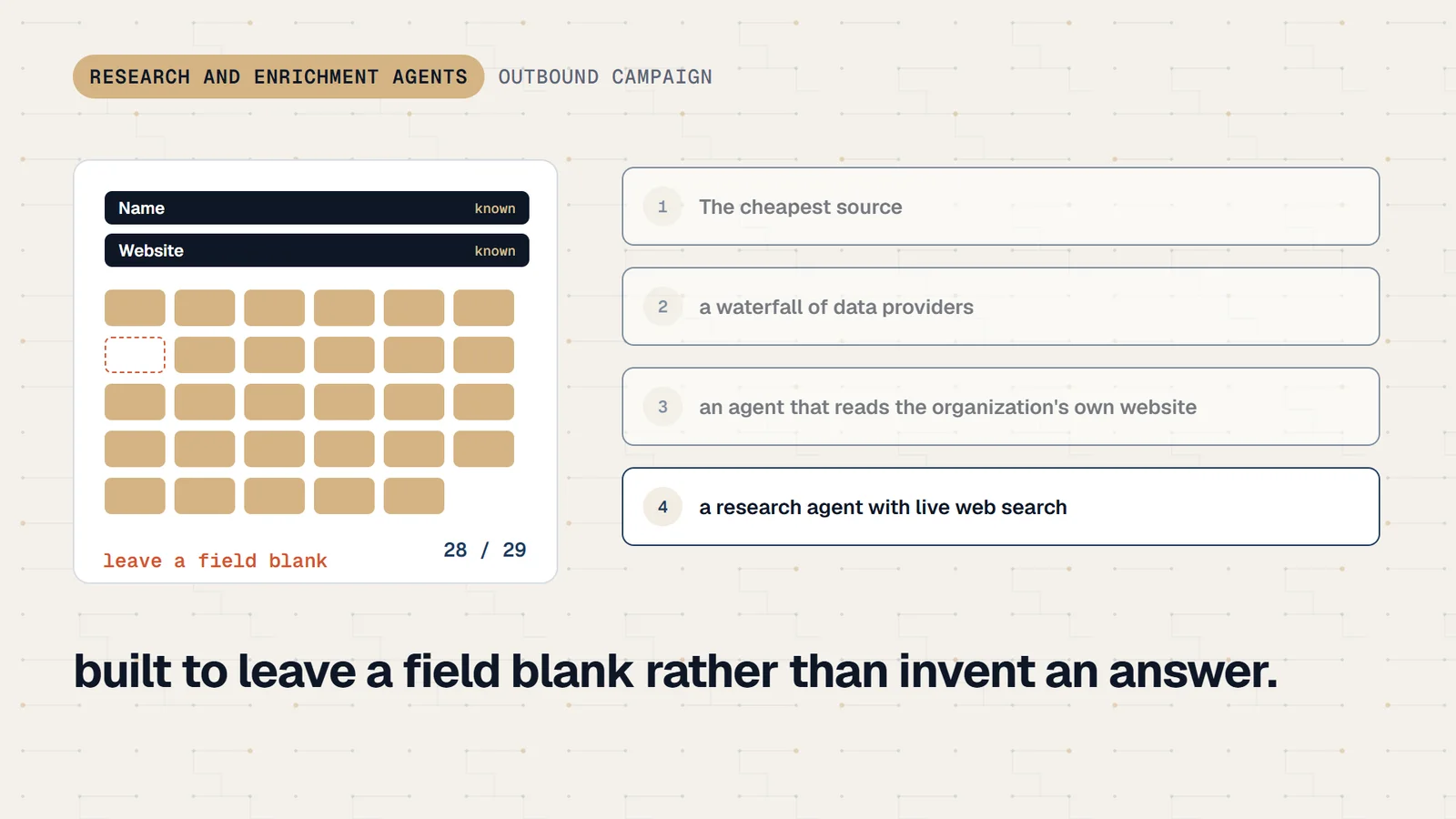
A cascade. Every lead starts at the cheapest source. After each step, the system measures how complete the record is. If it's good enough, it stops there and costs nothing more. If not, only the missing fields move down to the next, more powerful source: a waterfall of data providers, then an agent that reads the organization's own website and public filings, then a research agent with live web search.
That last agent is built to leave a field blank rather than invent an answer. Finished records go straight into sequencing, and the moment someone replies or bounces, the system stops spending on them.
What changed
Decision-maker-level data at campaign scale, with cost tied to how hard each lead is rather than how many leads there are, and a system designed never to make a field up.
Under the hood
Apollo, Clay, Firecrawl, Claude research agents, Instantly, n8n orchestration.